about 600 million years ago
The Elder Things’ Dominion
The [Elder Things](entity:creature-recall-creature-elder-things-6ad4a9ff15b8) came from distant universes and established themselves on Earth and three other planets. Partly material but profoundly unlike terrestrial life, they built windowless basalt cities and preyed on the beings they encountered.
Their ancient dominion formed the buried terror later remembered in legends of strange winds, whistling sounds, and sealed subterranean places. The Great Race would inherit a world already marked by their presence.
about a billion years ago
The Great Race’s Arrival
The minds of an older species, facing the death of their world, projected themselves forward into the bodies of the cone-shaped beings that inhabited Earth. The newcomers became the [Great Race of Yith](entity:creature-recall-creature-yith-great-race-of-y-d137858600be), carrying a mental heritage older than their adopted physical form.
Their ability to project minds across time would eventually let them study the past and future of Earth and other worlds. The technology also made possible exchanges in which minds were displaced into unfamiliar bodies and eras.
after the Great Race’s arrival on Earth
The Great Race’s Conquest
Using advanced instruments, the Great Race subdued the [Elder Things](entity:creature-recall-creature-elder-things-6ad4a9ff15b8) and drove them into the deep caverns beneath the surface. It sealed entrances to the underworld, though some passages and trap-doors were preserved as defenses against possible incursions.
The victory did not erase the danger. Reports of later breaches and attacks kept the Great Race wary, and the sealed passages became centers of an unspoken cultural fear.
about 150 million years ago
The Great Race’s Archive
At the height of its civilization, the Great Race maintained immense cities, roads, machines, and a central archive containing histories gathered from minds taken from many eras and worlds. Captives were allowed to explore and study, and some recorded the histories of their own times.
The archive preserved an account of Earth’s past and future, but the Great Race’s knowledge had limits: its members feared the [Elder Things](entity:creature-recall-creature-elder-things-6ad4a9ff15b8) below and knew that a future catastrophe would eventually force their own migration onward.
the future post-human beetle age
The Future Migration
The Great Race foresaw that the [Elder Things](entity:creature-recall-creature-elder-things-6ad4a9ff15b8) would one day rise against it. To escape that threatened destruction, it planned to project the minds of its strongest members into the bodies of a future species better able to survive.
The later hosts would be a beetle civilization. Peaslee’s dreams would preserve fragments of this projected future, turning an abstract account of succession into a personal and frightening memory.
June 1882
The Meteor Falls
A meteor came down near the well at [Nahum Gardner](entity:character-recall-character-nahum-gardner-be529f8688a0)’s farm, striking the ground beside the house and drawing astonished attention from the surrounding community. Nahum went to town to report it, and [Ammi Pierce](entity:character-recall-character-ammi-pierce-4068d3f88663) accompanied university professors who arrived to examine the strange visitor from space.
The meteor was hot, unusually soft, and already smaller than Nahum had first described. Its arrival began the sequence of events that would transform a prosperous farm into the [Blasted Heath](entity:location-recall-location-blasted-heath-9381c883b240).
June 1882, the days after the fall
The Vanishing Specimen
The professors removed a piece of the meteor for testing, but the sample behaved unlike any known terrestrial substance. It resisted ordinary reagents, gave off a strange spectrum, remained warm, and slowly diminished while interacting destructively with glass and other silicon compounds.
A coloured globule embedded within the meteor burst when struck and disappeared without leaving a trace. The investigators could not classify the material, and the unexplained colour became the first visible clue to the force affecting the farm.
June 1882, shortly after the tests
The Meteor’s Destruction
After a thunderstorm, the professors returned to find the meteor gone. Nahum said lightning had struck the same place repeatedly; the remaining ground showed only a ragged pit, and further digging revealed nothing.
The last laboratory fragment also vanished without residue. The scientists were left with no material evidence, while the meteor’s effects continued unnoticed in the soil and water around Nahum’s farm.
late summer and autumn 1882
The False Harvest
Nahum’s orchard produced unusually large, glossy fruit in remarkable abundance. But the apples, pears, melons, and tomatoes tasted bitter and sickening, making the entire crop inedible; Nahum suspected that the meteor had poisoned the soil.
The disaster seemed confined to the land closest to the fall, and the family initially hoped that other crops would remain safe. Instead, the ruined fruit marked the beginning of a broader corruption of the farm’s living things.
winter 1882–1883
Unnatural Winter Signs
Nahum grew withdrawn and worried about strange arrangements in the snow: familiar animal tracks seemed wrong in ways he could not explain. Ammi initially dismissed the concern, until a rabbit’s unusually long leaps frightened both him and his horse near the farm.
The Gardner dogs also became timid and nearly stopped barking. A deformed woodchuck and the animals’ growing fear added to the rumours gathering around the farm, though no one could say what was changing the countryside.
March and April 1883
The Strange Spring Growth
Abnormally large skunk-cabbages appeared near the farm, their shapes, colours, and odour unlike anything the local residents knew. The professors treated the plants as botanical oddities and dismissed the warnings of country people.
As spring advanced, the orchard and surrounding ground filled with diseased, prismatic colours that seemed faintly familiar to Nahum and Ammi. The vegetation made the meteor’s vanished globule seem less like an isolated curiosity and more like the source of an expanding blight.
spring 1883
The Trees Begin Moving
The Gardner family began listening for something they could not identify, and Thaddeus insisted that the trees moved even when there was no wind. His claim was first treated as childish imagination, but the family’s unease deepened as the trees and plants seemed increasingly alive in abnormal ways.
A passing salesman later noticed that the vegetation around the farm glowed faintly at night. That sight made the strange growth impossible to dismiss as mere gossip, even though the professors had already turned away from the case.
late spring 1883
The Poisoned Pasture
The farm’s grass and leaves turned grey and brittle, while the cows’ milk became tainted. Nahum moved the animals to higher ground, where the problem ceased, but the family and its property were already becoming isolated from their neighbours.
The livestock’s growing fear and the disappearance of ordinary animal sounds deepened the sense that the farm was being altered from within. The family’s daily life narrowed around the house as their physical and mental health declined.
June and July 1883
Nabby’s Madness
Nabby began raving about things moving in the air and about being drained by something she could neither name nor understand. Her speech broke into verbs and pronouns, as if the force afflicting her lay beyond ordinary description.
When the boys became frightened of her, Nahum locked her in an attic room. She soon stopped speaking, crawled on all fours, and seemed to glow faintly in the dark, turning the family’s fear into an intimate daily horror.
summer and early autumn 1883
The Livestock Collapse
The farm’s animals began to die or disintegrate in ways that ordinary disease could not explain. Poultry turned grey and brittle; hogs grew swollen before collapsing; and the cows suffered sudden, unnatural shrivelling despite being kept away from the corrupted pasture.
The dogs fled, and the cats had already left. With no livestock surviving, Nahum’s household lost both its livelihood and its last ordinary connection to the wider countryside.
September 1883
Thaddeus Sees the Colours
After going to the well for water, Thaddeus returned shrieking about moving colours below. Nahum shut him in an attic room when the boy’s condition became dangerous, leaving him separated from his mother and terrified younger brother.
The family’s fear was now tied directly to the well. The water had acquired an evil taste, but Nahum continued to drink it despite Ammi’s warning that it was no longer safe.
October 1883
Thaddeus Dies
Nahum went to Ammi with the news that Thaddeus had died in his locked attic room. What he found there was too terrible for him to describe, and he buried what remained of his son in the family plot.
The intact door and barred window ruled out an ordinary intruder. Ammi accompanied the grief-stricken Nahum back to the farm, where the sounds of Nabby and the increasingly disturbed Merwin made the household feel close to collapse.
October 1883, several days after Thaddeus’s death
Merwin Disappears
Merwin went to the well at night with a lantern and pail and never returned. Nahum searched through the night and found only the crushed, partly melted remains of the lantern and pail near the well.
He believed something was creeping through the farm and taking his family one by one. Exhausted and frightened, he asked Ammi to care for Nabby and Zenas if he himself did not survive.
November 1883
Ammi Finds Nabby
After weeks without seeing Nahum, Ammi visited the farm and found the house cold, silent, and surrounded by grey, crumbling vegetation. Nahum was alive but mentally broken, unable to give a clear account of Zenas’s whereabouts and insisting only that the boy lived in the well.
Ammi unlocked the attic and discovered Nabby’s remains in a state of horrible transformation. As he fled the room, a clammy vapour brushed past him and strange colours crossed his vision, suggesting that the unseen force remained active inside the house.
November 1883, moments after Ammi finds Nabby
Nahum’s Final Words
Ammi heard dragging and wet, sucking sounds downstairs, then found Nahum crumbling and barely able to speak. Nahum identified the force as a colour that had come from the meteor and lived in the well, feeding on the life of the family and their animals.
He said that Zenas had been taken after approaching the well and warned that the same force might still reach Nabby. Nahum collapsed before he could explain more, leaving Ammi with the belief that the well had drawn the family toward its destruction.
November 1883, that evening
The Well Is Emptied
Ammi told the authorities that the Gardner family was gone and accompanied them back to the farm. Investigators found the transformed remains of Nahum and Nabby, while laboratory samples later showed a strange spectrum that eventually faded.
At Ammi’s insistence, the men emptied and searched the well. They recovered partial remains of Merwin and Zenas, along with animal bones, from bubbling, porous mud that seemed to have no solid bottom.
November 1883, after nightfall
The Colour Rises
As the investigators gathered in the house, a pale beam of the familiar unnatural colour rose from the well. The trees began twitching without wind, and points of strange light appeared along their branches.
The glow spread across the farm’s organic matter, while the men realized that the force was growing stronger and seemed to be returning to the sky. Their inability to understand it did nothing to lessen the danger.
November 1883, moments after the Colour rises
The Farm Is Destroyed
The luminous force poured upward from the well and shot into the sky through a gap in the clouds. The men fled to higher ground as the farm, buildings, trees, and remaining vegetation blazed with alien colour.
A violent burst of sparks and strange fragments followed, and the farm vanished into darkness. Ammi alone saw a small remnant rise and sink back toward the well, leaving him convinced that the horror had not been wholly destroyed.
the years after November 1883
The Blasted Heath Remains
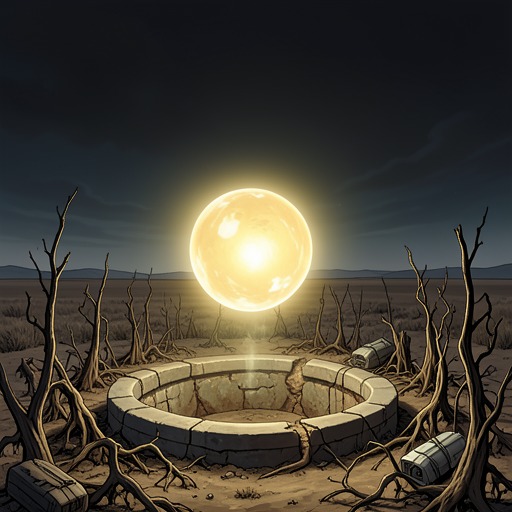
The farm left no true ruins beyond its chimney bricks, cellar stones, and the rim of the well. A patch of grey dust remained where five acres of living ground had once stood, and nothing grew there again.
People avoided the place, and Ammi never returned. Later stories claimed that the blight was spreading slowly around the edges, while the narrator noticed an unsettling change in the sunlight near the abandoned well and hoped a reservoir would bury the site.
1889–1908
Peaslee’s Early Life
[Nathaniel Wingate Peaslee](entity:character-recall-character-nathaniel-wingate-p-d68a07c5bb9e) entered [Miskatonic University](entity:location-recall-location-miskatonic-universit-4e8226582bca) in 1889, later studied at Harvard, and returned to teach political economy. He married Alice Keezar, and the couple had three children; by 1902 he had become a full professor.
His life appeared stable and conventional, with no interest in occultism or abnormal psychology. That ordinary history made the sudden change that overtook him in 1908 seem all the more alien to his family and colleagues.
May 14–15 1908
Peaslee’s Mind Is Displaced
While teaching a class at [Miskatonic University](entity:location-recall-location-miskatonic-universit-4e8226582bca), Peaslee experienced strange visions and collapsed. After hours of unconsciousness, he awoke speaking awkwardly and behaving as if he had lost his identity, though he tried to conceal the extent of his amnesia.
The personality in Peaslee’s body displayed unusual strength and an immense appetite for learning. His family recognized that the mind now inhabiting him was not the husband and father they knew.
1908–1913
The Alien Scholar’s Years
During the amnesia, Peaslee’s body travelled widely and pursued intensive studies in history, science, languages, and folklore. The new personality absorbed books at an extraordinary rate, visited remote regions, and showed occasional knowledge that seemed to reach beyond its own era.
Peaslee’s wife and two of his children recoiled from the altered man, and Alice eventually obtained a divorce. Only his son Wingate continued to believe that Peaslee’s original self would return.
September 27 1913
Peaslee’s Return
After five years, four months, and thirteen days, Peaslee’s original consciousness returned to his body. He resumed speaking in the middle of the economics lecture that had been interrupted by his collapse in 1908.
His return did not restore his former life. He had to learn what had happened during the missing years, and he was left with a persistent suspicion that his mind had been exchanged with something from outside human history.
1914–1915
The First Dream Fragments
After returning to ordinary life, Peaslee began having dreams of enormous stone chambers, vast cities, strange gardens, and unfamiliar writing. At first he treated them as ordinary dream material, but their vividness and recurring details began to resemble memories.
He also felt that time had become difficult to understand and that some barrier prevented him from grasping the meaning of his amnesia. The uneasy visions gradually connected his lost years to a world far outside his own experience.
1915 onward
The Dreams Become Memories
Peaslee’s visions became more detailed: he saw immense cone-shaped beings reading, writing, and moving through the ancient city. Eventually he looked down and recognized himself as one of them, waking in terror from the dream.
Within the visions, he understood that his mind had been taken from its own era and placed in a body of the Great Race. He spoke with other displaced minds and wrote a history of his own time for the civilization’s archives.
1915–1920
Peaslee Studies the Pattern
Peaslee researched historical and medical accounts of similar amnesia and found rare cases whose dreams resembled his own. Some accounts described strange machines, displaced identities, and ancient cities, strengthening his fear that the experiences were more than private hallucinations.
He also found unfamiliar annotations in books consulted during his amnesia, including strange hieroglyphs resembling those in his dreams. To protect himself, he constructed a rational explanation: the dreams were likely memories of folklore and forbidden learning acquired by the secondary personality.
around 1920–1922
Peaslee’s Psychological Defense
Peaslee concluded that his dreams and fears could be explained by the legends and occult texts he had encountered during his amnesia. This account gave him a defense against the growing sense that he had been displaced by a nonhuman mind.
The visions continued, but he returned to regular work in psychology in 1922. He recorded the dreams as a scientific document while trying to keep their apparent reality from governing his waking life.
November 3 1927
The Vermont Flood Sightings
After catastrophic floods in [Vermont](entity:location-recall-location-vermont-1342c569e4cb), reports emerged of strange organic bodies floating in the [Winooski River](entity:location-recall-location-winooski-river-369d18bfdd31), [West River](entity:location-recall-location-west-river-c96fef00d746), and [Passumpsic River](entity:location-recall-location-passumpsic-river-5c799d315b7c). Witnesses described pinkish, crab-like forms with wings, articulated limbs, and a cluster of feelers where a head should be.
The accounts echoed old stories of hidden beings in the hills. [Albert N. Wilmarth](entity:character-recall-character-albert-n-wilmarth-8a5f48be41fa), a folklore scholar at [Miskatonic University](entity:location-recall-location-miskatonic-universit-4e8226582bca), initially attributed the reports to frightened witnesses misreading human or animal remains through the lens of local legend.
late 1927–spring 1928
Wilmarth’s Public Skepticism
[Wilmarth](entity:character-recall-character-wilmarth-d47935f51564) argued publicly that the [Vermont](entity:location-recall-location-vermont-1342c569e4cb) legends were part of a familiar pattern of folklore, not evidence of a hidden nonhuman race. His position prompted a written debate with people who believed that the consistent details of the flood reports deserved serious attention.
The controversy drew notice in Vermont newspapers, making Wilmarth a recognizable figure there despite his never having visited the state. It also brought him into contact with a correspondent who claimed to possess direct evidence.
May 5 1928
Akeley’s Warning Letter
[Henry Wentworth Akeley](entity:character-recall-character-henry-wentworth-ake-93c29fcafdce) wrote to [Wilmarth](entity:character-recall-character-wilmarth-d47935f51564) from [Townshend](entity:location-recall-location-townshend-d353d4aeff5e), saying that he had explored the hills and found strange tracks, heard voices, and witnessed beings resembling those in the old legends. He described them as visitors from another world who mined under the hills and maintained secret outposts.
Akeley warned that the beings had spies among humans and urged Wilmarth to keep the debate quiet. He offered to send a phonograph recording, photographs, and a black stone covered with unfamiliar marks.
May 1928
Akeley’s Photographic Evidence
Akeley sent [Wilmarth](entity:character-recall-character-wilmarth-d47935f51564) photographs of a claw-like track, a blocked cave, a stone circle, and the black stone he had found at [Round Hill](entity:location-recall-location-round-hill-ab8e8412d64d). The images appeared to show evidence that could not easily be dismissed as a simple double exposure or fabricated footprint.
Some of the stone’s markings reminded Wilmarth of forbidden writings, including the [Necronomicon](entity:object-recall-object-18c8746b1349). The photographs weakened his confidence in his own scepticism, even though he still hoped to find an ordinary explanation.
May–June 1928
Akeley’s Cosmic Account
In a long letter, Akeley described strange beings in the hills and set their presence within a vast mythic history. He identified them with the [Mi-Go](entity:creature-recall-creature-mi-go-09261f0af775) and said they came from beyond Earth to mine metals and gather knowledge, while some humans secretly aided them.
[Wilmarth](entity:character-recall-character-wilmarth-d47935f51564) was shaken by the evidence and the scholarly care of Akeley’s account. Their correspondence turned from a public dispute into a private investigation of the beings and the legends surrounding them.
May-Eve 1915; received in June 1928
The May-Eve Recording
Years before contacting [Wilmarth](entity:character-recall-character-wilmarth-d47935f51564), Akeley had taken a phonograph to a cave on [Dark Mountain](entity:location-recall-location-dark-mountain-f4509c651c1d) on [May-Eve](entity:time-recall-time-may-eve-784605909247) and recorded a ritualistic exchange. One speaker sounded like an educated human, while another replied in a buzzing imitation of human speech.
When Wilmarth listened to the record in 1928, the alien voice and the ritual’s references to forbidden powers made the [Vermont](entity:location-recall-location-vermont-1342c569e4cb) legends feel immediate and real. The recording became a crucial link between the beings in the hills and human collaborators.
July 1928
The Black Stone Disappears
Akeley arranged to send the black stone to [Wilmarth](entity:character-recall-character-wilmarth-d47935f51564) by rail, routing it through [Bellows Falls](entity:location-recall-location-bellows-falls-735a784da9d0). The box never arrived, and railway employees recalled a stranger with a thick, droning voice making inquiries about an expected shipment at [Keene](entity:location-recall-location-keene-2a68e22962f2).
Akeley suspected that the beings or their agents had intercepted the stone. Wilmarth’s frustration at losing a potential source of knowledge was overshadowed by the sense that unseen forces were tracking their correspondence and movements.
August 1928
The Siege Intensifies
Akeley reported that the beings were closing in on his isolated farmhouse. Roads were obstructed, gunfire came near his car, and he found tracks around his property; during one night attack, several of his dogs were killed.
He bought more dogs and ammunition, but the siege grew more dangerous. Akeley believed that the hill beings and their human agents were trying to prevent him from leaving and might take him away alive.
late August 1928
The False Telegram
A telegram arrived telling [Wilmarth](entity:character-recall-character-wilmarth-d47935f51564) not to intervene, but Akeley denied sending it or receiving the letter it appeared to answer. The message had been deposited by a strange, sandy-haired man with a droning voice, and its signature misspelled Akeley’s name.
The deception intensified their fear that the beings could manipulate communications and impersonate human contacts. Akeley remained trapped between his desire to flee and an inexplicable inability to leave his home and the region.
September 1928
The Dead Mi-Go
Akeley wrote that he had found the body of one of the beings near his kennel after a night of fighting. He described its crab-like shape and green fluid, but said that the corpse evaporated before he could show it to anyone or preserve photographic evidence.
He also reported that [Walter Brown](entity:character-recall-character-walter-brown-381379b35d3d) had disappeared and that he intended to try poison gas before appealing to the sheriff. His letter ended with another warning to [Wilmarth](entity:character-recall-character-wilmarth-d47935f51564) to destroy the recording and stay away.
September 6 1928
Akeley Claims Reconciliation
A typed letter from Akeley reversed the desperate tone of his earlier messages. He said that a human messenger had explained the visitors’ peaceful intentions and that the beings wanted intellectual exchange rather than harm to humanity.
Akeley now portrayed himself as their chosen interpreter and invited [Wilmarth](entity:character-recall-character-wilmarth-d47935f51564) to visit. The abrupt change in his attitude troubled Wilmarth, but the promise of extraordinary knowledge overcame much of his suspicion.
September 12 1928
Wilmarth Travels to Vermont
[Wilmarth](entity:character-recall-character-wilmarth-d47935f51564) travelled from [Boston](entity:location-recall-location-boston-aded649f4602) to [Brattleboro](entity:location-recall-location-brattleboro-e1ce095990ed) carrying Akeley’s letters, photographs, and phonograph record. At the station, a neatly dressed man calling himself [Noyes](entity:character-recall-character-noyes-cf9d583808f4) met him instead of Akeley and explained that Akeley was ill.
Noyes drove him through the crowded green hills toward [Townshend](entity:location-recall-location-townshend-d353d4aeff5e). His cultured voice seemed strangely familiar to Wilmarth, and the landscape’s isolation made the journey feel like a passage into a place cut off from ordinary life.
September 12 1928, afternoon
The Tracks at the Farm
At Akeley’s farmhouse, [Wilmarth](entity:character-recall-character-wilmarth-d47935f51564) noticed several fresh claw-like tracks among the marks in the road. The evidence contradicted the claim that the beings had made peace with Akeley, but he tried to believe that their presence was now harmless.
The farm itself seemed unnaturally silent, with no visible dogs or livestock. [Noyes](entity:character-recall-character-noyes-cf9d583808f4) left Wilmarth at the door, and the visitor entered alone to meet the man he had known only through letters and photographs.
September 12 1928, late afternoon
Wilmarth Meets Akeley
[Wilmarth](entity:character-recall-character-wilmarth-d47935f51564) found Akeley seated in a darkened study, rigid and apparently very ill. The old farmer spoke in a whisper and eagerly discussed journeys beyond the solar system, the planet [Yuggoth](entity:location-recall-location-yuggoth-078da9a5ca16), and the beings’ immense knowledge.
Akeley asked Wilmarth to bring out the documents and recording. Although the man’s appearance and manner disturbed him, Wilmarth remained willing to hear the promised revelations and hoped that a conversation would clarify the sudden change in Akeley’s outlook.
September 12 1928, evening
The Brain Cylinders
Akeley explained that the beings could transport human brains in metal cylinders connected to instruments that reproduced sight, hearing, and speech. He showed [Wilmarth](entity:character-recall-character-wilmarth-d47935f51564) rows of cylinders and the machines used to communicate with the brains inside them.
The apparatus made the notion of interstellar travel tangible and more disturbing than Akeley’s abstract descriptions. Akeley instructed Wilmarth to connect one cylinder to its sensory equipment and activate the machines.
September 12 1928, evening
The Brain Speaks
A mechanical voice spoke from the activated apparatus, claiming to belong to a human brain housed in a cylinder. The speaker said that its body was being kept elsewhere and described journeys to many celestial bodies, inviting [Wilmarth](entity:character-recall-character-wilmarth-d47935f51564) to travel with Akeley and the visitors.
The testimony framed the procedure as painless and the promised experience as a chance to explore worlds beyond human imagination. Wilmarth was unnerved by the machine’s unmistakable presence but did not yet know whether to trust what he had heard.
September 12 1928, night
Wilmarth’s Doubts Return
After leaving the study, [Wilmarth](entity:character-recall-character-wilmarth-d47935f51564) became increasingly troubled by Akeley’s motionless body, the strange odour, and the whispering voice. He decided that he could not safely spend another night in the farmhouse and resolved to wake Akeley and leave.
The sounds of a gathering below and the earlier attempt to drug him with acrid coffee sharpened his suspicion. He believed that he and Akeley might have been drawn into a trap, despite the reassuring story of peaceful contact.
September 13 1928, before dawn
The Empty Chair
When [Wilmarth](entity:character-recall-character-wilmarth-d47935f51564) went downstairs, he found [Noyes](entity:character-recall-character-noyes-cf9d583808f4) asleep in a living room rather than Akeley. In the study he saw a cylinder bearing Akeley’s name, while Akeley’s dressing gown, yellow scarf, and bandages lay beside an empty chair.
The odour and vibration that had surrounded the seated figure were gone. The clothing and the apparatus suggested that the sick man Wilmarth had spoken to might not have been Akeley’s living body at all.
September 13 1928, before dawn
Akeley’s Artificial Face
Looking again at the chair, [Wilmarth](entity:character-recall-character-wilmarth-d47935f51564) saw three cleverly constructed objects concealed among the clothing. They were a face and hands so finely made that they could imitate Akeley’s appearance in minute detail.
He understood the whispered figure to have been an imposture or a mechanical substitute, while the real Akeley might have been removed or reduced to a brain in a cylinder. The revelation left him with no way to know who, or what, had occupied the chair.
September 13 1928, before dawn
Wilmarth Escapes
[Wilmarth](entity:character-recall-character-wilmarth-d47935f51564) fled the farmhouse in Akeley’s old Ford, driving through the dark hills until he reached [Townshend](entity:location-recall-location-townshend-d353d4aeff5e). He left behind the devices, the gathering below, and the body or imitation that had appeared in the study.
A sheriff’s party later found no cylinders, machines, or evidence of a guest, only Akeley’s clothes and bullet holes in the house. Akeley himself had vanished, and Wilmarth never learned what had truly happened to him.
1929–1930
Pluto Confirms Yuggoth
After leaving [Vermont](entity:location-recall-location-vermont-1342c569e4cb), [Wilmarth](entity:character-recall-character-wilmarth-d47935f51564) learned that the strange hill country had a long record of disappearances and local avoidance. The report that a new ninth planet had been observed beyond Neptune seemed to confirm Akeley’s claim that [Yuggoth](entity:location-recall-location-yuggoth-078da9a5ca16) would soon become known to astronomers.
The discovery did not prove that the planet was inhabited, but it deepened Wilmarth’s fear that the beings had deliberately directed human attention toward it. He resolved to keep away from the Vermont hills and their hidden outposts.
1928–1929
Peaslee Publishes His Case
Peaslee published accounts of his amnesia, dreams, and research in psychological journals. His articles included sketches of the strange buildings and symbols he remembered, but attracted little attention outside specialist circles.
He continued keeping detailed records of his dreams, treating them as a psychological document rather than proof of an actual ancient captivity. That guarded interpretation would be challenged by evidence from Australia.
May–July 1934
The Australian Ruins Letter
A letter from mining engineer [Robert B. F. Mackenzie](entity:character-recall-character-robert-b-f-mackenzi-377327f5301f) reached Peaslee through the Psychological Society. Mackenzie described ancient dressed stones in the [Great Sandy Desert](entity:location-recall-location-8430a67ca110) whose curved surfaces and carvings resembled the ruins in Peaslee’s dreams.
He enclosed photographs that showed the same masonry patterns and invited Peaslee to organize an expedition. The possibility that the dream-city had left physical remains unsettled Peaslee’s long-held explanation of his experience.
March 28 1935
The Expedition Sails
[Miskatonic University](entity:location-recall-location-miskatonic-universit-4e8226582bca) backed an expedition led by Peaslee, accompanied by his son Wingate, [William Dyer](entity:character-recall-character-william-dyer-a50f3975a826), other scholars, Mackenzie, and local support. The party sailed from [Boston](entity:location-recall-location-boston-aded649f4602) toward [Western Australia](entity:location-recall-location-2e08b934e5bc), keeping its specific purpose out of sensational public reports.
The journey placed Peaslee’s personal history inside a formal archaeological investigation. He hoped that careful excavation might explain the stones without confirming the terrifying reality suggested by his dreams.
June 3 1935 onward
The Buried City Stones
The expedition reached the desert site and began uncovering blocks of ancient masonry. Over the following month, the party found about 1,250 stones, many with the curved tops and bottoms, carved patterns, and shapes Peaslee had repeatedly seen in his dreams.
The fragments appeared scattered by immense geological upheavals, and the deeper excavations produced no clear plan of the original structures. Even so, Peaslee could no longer regard the resemblance between the ruins and his visions as a casual coincidence.
July 11 1935
The Basalt Block
On a solitary night walk, Peaslee uncovered a square-cut block of dark basalt unlike the sandstone and granite found elsewhere at the site. He recognized it from his research as the kind of windowless masonry associated with the ancient beings the Great Race had feared.
Peaslee panicked and ran back to camp, then felt embarrassed by his reaction. When he returned with the others the next day, shifting sand had hidden the stone again.
17 July 1935, late evening
Peaslee’s Night Walk
Unable to sleep and drawn by a powerful sense of familiarity, Peaslee walked northeast from the camp beneath the moon. The desert seemed to blend with the ancient city of his dreams, and he felt that he was following a destination he had known in another life.
A sudden wind later tore through the camp, although the sky was clear. Peaslee returned near dawn, scratched, exhausted, and without his flashlight, but initially described his absence as a frightening dream and a panic-driven flight.
the night of 17–18 July 1935
The Buried Entrance
Peaslee’s account of his walk described finding a large heap of blocks whose carvings formed parts of a single design. The masonry matched a corridor from his dreams so precisely that he seemed to know the buried city’s layout before he uncovered it.
He felt cool air rising from a depression beneath the stones and moved the blocks aside, exposing an opening into a deep subterranean structure. Against ordinary judgment, he descended alone into the darkness.
the night of 17–18 July 1935
The Ancient Corridor
Below the opening, Peaslee found a vast ruined corridor with walls and flooring that matched the structures he had seen in dreams. He knew where passages, levels, machine rooms, and a sealed trap-door ought to be, despite never having visited the place in waking life.
The knowledge felt less like archaeological inference than recovered memory. Peaslee followed the familiar route farther into the underground city, increasingly convinced that the dreams had preserved genuine experience.
the night of 17–18 July 1935
The Great Race’s Archives
Peaslee crossed collapsed passages and reached the immense underground structure he recognized as the Great Race’s central archive. Its metal shelf-doors and surviving cases seemed to match the dream-city’s records, despite the damage caused by geological ages.
He found a volume written in a language he associated with one of the minds he had met in his dreams. Its presence made the buried archive appear real, while the dust and silence testified that no human visitor had entered it for an immense span of time.
the night of 17–18 July 1935
The Disturbed Dust
Near a yawning trap-door, Peaslee noticed faint regular impressions in the dust. The marks appeared in repeated groups of three, each composed of five round prints, and seemed to lead both toward the fallen archive cases and back toward the opening below.
The pattern resembled the strange footprints linked in his dreams to the [Elder Things](entity:creature-recall-creature-elder-things-6ad4a9ff15b8). The possibility that something had recently passed through the ancient archive turned his exploration into a race against an unseen presence.
the night of 17–18 July 1935
Peaslee Finds His Record
Driven by a powerful, almost bodily memory, Peaslee climbed to a particular archive shelf and opened its intricate lock. He removed a metal case that he recognized as his own and found a book within it.
When he shone his torch on the page, he saw English words written in his own handwriting. The discovery seemed to prove that, during the amnesia, he had lived among the Great Race and written his own era’s history for its archive.
the night of 17–18 July 1935
The Whistling Pursuit
As Peaslee tried to return through the ruined corridors, the case clattered against fallen stones. He heard a shrill, unearthly whistle from behind, then realized that the sound and a forceful wind were coming from ahead as well.
The wind seemed to impede him and curl around him like a noose. Peaslee fled through the subterranean ruins, convinced that something in the deep passages had become aware of him.
the night of 17–18 July 1935
The Collapse and Escape
Peaslee’s flight triggered a crashing avalanche of masonry, and the alien whistling answered from the depths. He reached the surface only through a desperate scramble over fallen stones, leaving the metal case and flashlight behind.
Near dawn he staggered back to camp battered and torn. He could not tell whether the underground encounter had happened or whether he had wandered through a nightmare in the desert, but the experience shattered the confidence he had built in his psychological explanations.
July 1935, aboard the homebound ship
The Unproven Revelation
Peaslee wrote an account of the experience for his son Wingate, explaining that the expedition had found ancient ruins but that he alone had entered the buried structure. His injuries and the missing flashlight offered no decisive proof, and the shifting desert sand concealed the place where he believed the entrance had been.
The final revelation was the book in the metal case: its pages bore English writing in Peaslee’s own hand. He warned against further excavation, while conceding that the entire experience might have been a delusion and fearing what it would mean if the buried city and its history were real.